For businesses today, digital value creation is central to staying competitive and meeting changing customer needs. It is not only about adopting technology but about how you integrate it with strategy to create value that is real. Drawing on my experience, I want to share the IDEAS framework, a model for driving business outcomes.
A new era for digital
Not long ago digital transformation was the buzzword, and it mostly meant adopting new technology. Now it is about integrating technology and strategy with some imagination. With the pace of change, implementing technology is not enough; companies have to keep experimenting.
Rigid, reactive business models no longer work. The focus is on understanding customers and meeting their emerging needs quickly.
IDEAS is not a silver bullet. It is not a bad conversation starter.
Where IDEAS came from
Leading digital innovation, a recurring challenge was clear communication about how a product or service should be designed. With many talented people from my team and our partners, we created the IDEAS framework, drawing on lean start-up, jobs-to-be-done, pragmatic marketing and dual-track agile.
IDEAS is more than a method. It gives a systematic way to develop new propositions that is more consistent, more teachable and more worth investing in.
The five stages
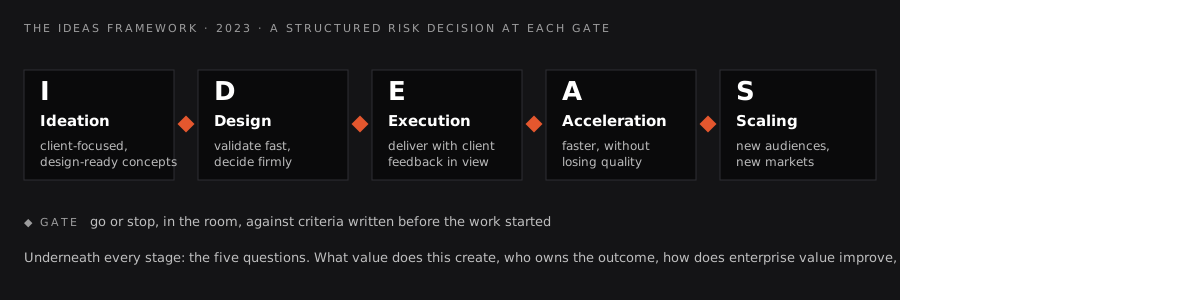
Each letter is a phase:
I · Ideation. Gathering and shaping ideas. The foundation, keeping the effort client-focused and aiming for design-ready concepts with a clear business perspective.
D · Design. Creating client-centred solutions. With expert partners, a thorough design and validation process aimed at reaching firm decisions quickly. A design system here means producing more and updating faster.
E · Execution. Where strategy meets action. Using internal assets and partnerships to deliver the product or service, with client feedback and market conditions in view.
A · Acceleration. Ramping up. Applying what the earlier phases taught to deliver faster and more efficiently without losing quality.
S · Scaling. Once a product is proven, expanding it: wider audiences, new markets, operations that can meet the demand.
The role of structured risks
How can businesses that are not digital natives take these opportunities? Having led a number of digital transformations and product developments, one element is indispensable: structured risks.
Structured risks are planned, measured actions that balance fast innovation with stability. They rest on informed choices that weigh the upside and the downside. Built into IDEAS, they mean the decision at each stage gate is both strategic and calculated.
Businesses need to combine speed, focus, flexibility and collaboration. Managing risk while moving fast is the skill. Agile and design-thinking habits help balance innovation with implementation.
A client-focused model
Businesses are increasingly shaping services and products around what their clients need. IDEAS is a tool for that shift: structured, but adaptable enough to bring client insight into strategy. That matters most in markets where loyalty moves quickly with experience.
Every journey is different
Each company's path is shaped by its own challenges and opportunities. IDEAS works because it can be adapted to an organisation's particular needs and goals. It is not a silver bullet. It is not a bad conversation starter.
With thanks to the architects and contributors to this work over the years: Mohanvir Singh Saran, Elinor Davies, Guillermo Torres, Michael Beeson, Asad Rahman, Tom Sutton, Hubert Turaj, Fiona Robinson, Karl Eddy, Glen Atherfold, EDISONDA, Noel Webb, Samuel Knight, Tom Humphreys.